YOUR CART
IS EMPTY
IS EMPTY

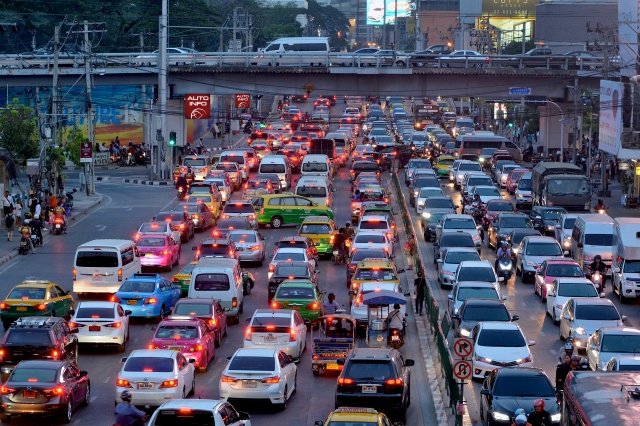
What causes "traffic jams" ? Many of you surely have more than one answer in mind! From numerous problems, day by day, a huge number of cars will fill every area on the road, while the road surface remains the same. Traffic problems follow suit. No government will certainly be able to solve traffic jams if we don't cooperate.
Many people complain! If our public utility system was efficient and had comprehensive services, "I" "I" "I" (referring to myself)... wouldn't need to buy a car...!?! If that were true, the number of cars in use would definitely decrease. And if what we dream of is still slowly coming true, the number of cars in use continues to increase daily. We should start with the drivers, especially “newbie” drivers who just ”can drive” and immediately go out on the road, even if they have already attended driving school. But in reality, they just get a driver's license and that's it. When in fact, driving requires more than just a driver's license that says you are allowed to drive.
Things you already know, like various traffic laws, probably don't need to be explained from scratch. If anyone forgets any point, you can search for information on Google. But today, if you've just started driving, or if you've been driving for a long time but might have forgotten! Some essential things. Let's see how often you use these basic principles? Let's take a look!
1. Turn signals are very important equipment, but many people don't use them much!?! Let's see why >
Turn signals were universally designed by engineers to be easily accessible to the driver and most convenient to use. Because if you use them when turning, overtaking, or making a U-turn...whenever? They will greatly enhance safety by indicating your direction to fellow drivers behind you. Don't just turn when you want to, or overtake when you want to. If you think or many people forget! This way, accidents are sure to happen. Click to see the results of not signaling when turning or overtaking...>
2. Emergency lights should not be used excessively!
Emergency lights have a triangular symbol, or sometimes the word EMERGENCY instead. If you notice their position, manufacturers choose to place them neither too close nor too far, meaning drivers can activate them quickly, but not as conveniently as turn signal switches (which surprisingly few people use when turning...!!!???). However, many people use them incorrectly. Because when you turn on the emergency lights, you are signaling with both turn signals simultaneously. And the word 'emergency' implies that the vehicle cannot move forward or has been involved in an accident. Many may have been taught to turn on emergency lights during rain or when crossing an intersection without traffic lights, but these are all incorrect ideas, as they will confuse drivers behind you and could eventually lead to accidents. (Watch clip: >When to use emergency lights)
3. Brakes...use only when stopping!
Many drivers “brake” for no reason. They just keep braking. The road ahead is clear...leaving a long gap... Have you ever seen this? Try to find a chance to overtake this car, and you might see the driver - talking or playing on the phone - smoking - eating, etc. All sorts of behaviors. If you're following this type of car, just find a chance to overtake! ...Anyone still exhibiting such behavior, please stop immediately! This not only irritates the cars behind you but also causes traffic jams, and more importantly, your car could be the cause of an accident. Because such behaviors distract the driver, slow down reaction times. Loss of concentration while driving is one of the main causes of accidents.
Because normally, brakes are used to slow down and stop the car. But it's this understanding of slowing down that leads many new drivers to tap the brakes almost constantly, causing misunderstanding for other drivers, as the brake lights at the back also illuminate when braking. This also leads to more wear and tear than necessary just to maintain speed.
The solution to this problem is to learn accelerator control, which most driving schools don't teach. But if today you're a driver who is dependent on using the brake, try starting by easing off the accelerator first, then gradually pressing it down to match the desired speed. This should be better. Although it might feel unfamiliar at first, ultimately, once you understand how it works, you'll realize that the brake isn't the only thing that can slow down your car.
4. The "horn" can be used (to warn), but most people don't use it much.
The horn signal is an audible warning used to alert road users to be more careful by letting them know the location of the signaling vehicle. The correct use of the horn should be short signals. It is strictly forbidden to use the horn for longer than necessary, except in genuinely urgent emergencies. Violation carries a fine not exceeding 500 baht. The horn should be used when driving through sharp bends where oncoming vehicles or blind spots are not visible, and in alleys with opaque walls to signal other vehicles. Importantly, avoid using the horn to scold other drivers. At the same time, the car stereo should be played at the recommended volume level, which should not exceed 85-90 decibels.
Because sounds louder than specified will unknowingly damage the hearing of those inside the car, and playing the stereo too loudly will prevent the driver from hearing horns or other signals that other vehicles want to send, which could lead to unexpected accidents.
The reality of car use internationally is that the horn is a warning signal, not high-beam flashing. There are only a few places where its use is prohibited, such as educational institutions, temples, and hospitals. Other places do not explicitly prohibit it. Therefore, if you encounter a problem that could lead to an accident, what you should do is honk the horn to warn fellow road users, but not so excessively that it becomes annoying.
5. Straddling road lanes
Not committing to a direction, driving left, then right, then quickly back to the original lane, and also straddling lanes and encroaching on adjacent lanes, can cause problems for cars following behind. They can't know which way you're going. Furthermore, when turning in or out, you should drive straight within your lane, otherwise you might scrape or collide with other cars.
6. Fast drivers keep right, slow drivers keep middle.
This point is important and frequently encountered. For newbies or veterans who drive slowly yet stay in the outermost right lane. Newbies absolutely must not imitate this! It's unclear for what reason some cars drive slowly and linger in the right lane. Cars behind honk to warn, flash high beams to request passage, but they still don't yield, or perhaps they don't hear the horn because the radio is loud, or they're busy talking on the phone while driving, or they don't see the high beams requesting passage because they never look in the rear-view mirror. **To newbies," did you know! Driving slowly in the right lane and leaving several kilometers of gap prevents those in a hurry from overtaking. When pressured too much, drivers can panic, which can cause danger, and also leads to numerous traffic jam problems. Therefore, if you are driving in the right lane and see a faster car behind you in your rear-view mirror, quickly find an opportunity to let them pass. If you can't find an immediate opening, turn on your right signal to indicate. Once it's safe, quickly make way for your fellow driver.
7. Driving while chatting, calling, or...
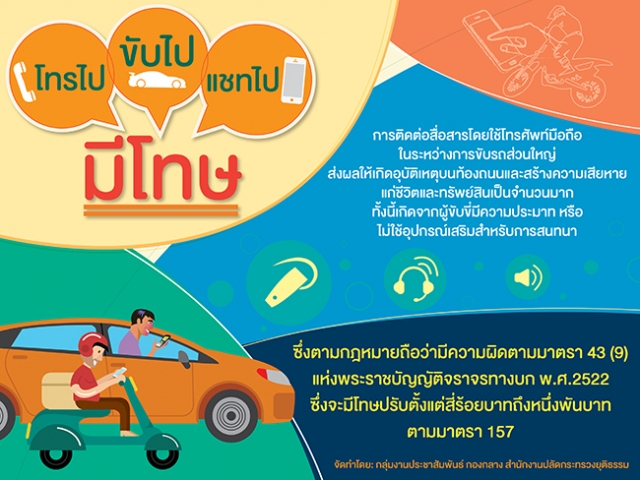
Although this point is supported by law...stating that the Land Traffic Act B.E. 2522 (1979) stipulates in the part related to this matter:
.....Section 4 In this Act, etc. (28) “Driver” means a person who drives a vehicle.
.....Section 43 A driver shall not drive a vehicle
.......etc.
.......(9) While using a mobile phone, except for using a mobile phone with an accessory for conversation where the driver does not have to hold or grasp the mobile phone.
.....Section 157 Any person who violates or fails to comply with Section 43 (9), etc., shall be liable to a fine from 400 Baht to 1,000 Baht.
But many people still violate this, overlooking safety.
Watch accompanying clip..>
Question...> How often should we look in the side and rear-view mirrors? > According to standards, you should look periodically. Before slowing down, before changing lanes, before turning on the turn signal, you must also check if it's safe to change (not just turn on the signal and immediately move out!). When changing lanes or merging into a main road, you still need to turn your head and look, not just rely on the mirrors alone. Even when stopped at a red light, you should still keep looking in case a car has brake failure. If we see it early, we might have a chance to prepare in time... I emphasize! Driving requires constant "awareness."
All of the above can be considered just a part of safe driving on roads full of diverse people. Although the road might be unfamiliar to new drivers, driving experience will teach you that correct driving might not always be as recommended by driving schools...
Safe driving must not be based on "negligence." Always remember that -we must not drive into others, -we must not let others drive into us, and -we must not cause others to collide... It seems simple, but drivers must study and utilize their road experience to their advantage. The chances of accidents will decrease. Thank you for reading to the end and putting this into practice. If any of you missed any points, it's still not too late to quickly correct and improve. At least you'll start with yourself and then tell those close to you, because paying attention to small details that are often overlooked will help create safety for drivers and fellow road users !!!


Follow Motor Expo Club Network